
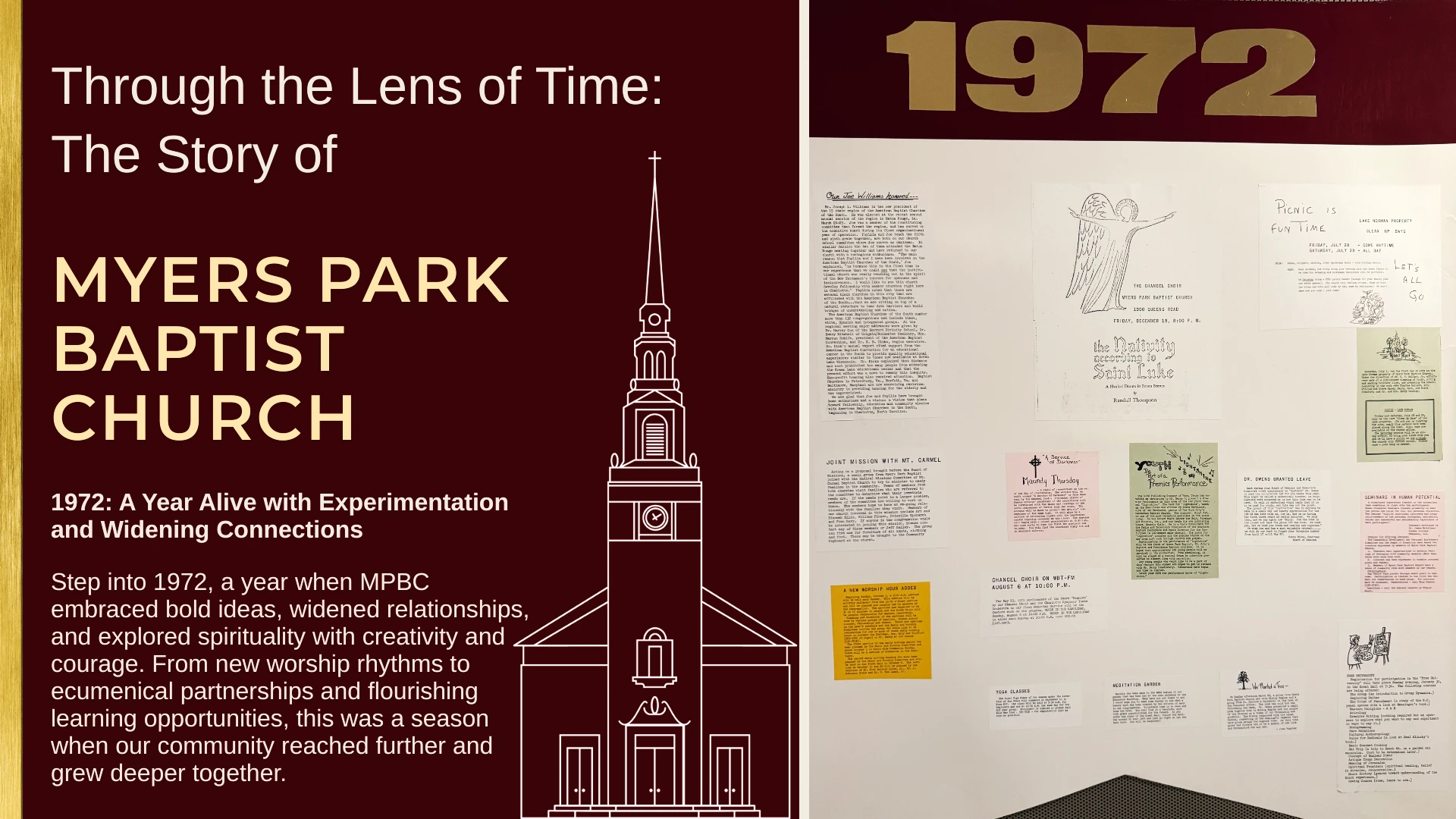
1972: A Year Alive with Experimentation and Widening Connections
1972 was a year when Myers Park Baptist Church leaned boldly into the future—embracing new partners, new ideas, and new ways of being community. It was a season of curiosity and courage, when racial and ecumenical relationships deepened, worship expanded in creative directions, and spiritual exploration flourished in classrooms, gardens, sanctuaries, and lakeside retreats. From regional Baptist leadership to neighborhood partnerships, from emerging spiritual practices to vibrant youth creativity, the church stretched its arms wide. The result was a year alive with experimentation, connection, and an ever-growing embrace of the world around us.
Strengthening Baptist Partnerships Across the South
Joseph L. Williams was elected president of the 15-state region of the American Baptist Churches of the South. A founding leader in the region, Joe and his wife Phyllis returned from the Baton Rouge meeting inspired by a renewed vision of openness and inclusiveness rooted in the New Testament. Both were deeply involved in the life of Myers Park Baptist, teaching the fifth and sixth grade class together and serving on the MPBC school committee, where Joe was chairman.
Joe shared that their involvement with the organization stemmed from recognizing that "for the first time they could see "that for the first time...the institutional church was reaching out in the spirit of the New Testament's concern for openness and inclusiveness." Phyllis noted the significance of several black churches in Charlotte that were affiliated with the American Baptist Churches of the South and observed that, "we are sitting on top of a natural structure to tear down barriers and build bridges of understanding and action."
With more than 132 congregations affiliated with the organization including Black, white, Spanish and integrated groups, it showcased that the region fostered an increasingly diverse Baptist fellowship. The annual meeting featured influential voices such as Harvey Cox (Harvard Divinity School), Henry H. Mitchell (Colgate/Rochester Seminary), Mrs. Marcus Rohlfs (president of the American Baptist Convention), and Dr. E. B. Hicks (region executive) Initiatives included a Southern educational center to provide quality educational experiences modeled after Green Lake Wisconsin. Nonprofit housing and ministry initiatives were also expanded in Petersburg and Norfolk, VA and Baltimore, MD providing housing and support for the elderly and the impoverished.
Shared Mission in Charlotte: A Partnership That Served and United
Myers Park Baptist partnered with Mt. Carmel Baptist Church to serve families in need through a shared mission effort. Together, members provided food, clothing, and furniture while building ongoing relationships of care. Teams from both congregations visited families to determine their immediate needs. If the needs pointed to larger challenges, members of the committee worked to resolve them.
The initial Myers Park Baptist Church team included Art and Diannah Ellis, William Pinson, Priscilla Upchurch, and Fran Kerr. This hands-on ministry embodied a growing commitment to community engagement and interracial cooperation at a critical moment in Charlotte's history.
A New Worship Rhythm: The 9 a.m. Service Takes Shape
October brought a creative new venture—a 9 a.m. worship service led largely by members and youth. These 30–40-minute services were planned and shaped by families, church school classes, and fellowships, who coordinated through the Music and Worship Committee by contacting Mrs. Mary Ann Clifford, chairman, or Mr. James Berry.
The first service occurred on World Communion Sunday included a service of Communion that affirmed global Christian unity. The first services were planned by the families of Dr. Fred Huntley Allen, Jr., Dr. J. Robinson Hicks, and Dr. R. Ted Lucas, Jr. The new worship hour encouraged experimentation, participation, and a sense of shared ownership in worship life.
A Holy Night of Shadows and Remembrance
The Maundy Thursday service serves as a night of remembrance on the eve of the day of crucifixion. In 1972, the service was built around A Service of Darkness by Dale Wood, sung by the Chancel Choir. Projected slides of famous artists' paintings of the crucifixion were correlated with the music and the readings of the seven utterances of Christ from the cross, creating a multisensory experience of profound depth. As candles dimmed one by one, worshipers were drawn into the quiet unfolding of Holy Week, concluding the service in absolute silence.
Expanding the Inner Life: Spiritual Practices and Learning
Human Potential Seminars
The church broadened its spiritual practices and learning opportunities through Human Potential Seminars. The seminars elicited individual discovery and group reinforcement of personal strengths, values, motivations, and the successful and satisfactory life experiences of each participant.
Yoga with Ann Owens
Yoga Classes were offered at 9:30 a.m. for beginners and at 10:30 a.m. for more experienced participants and were taught by Ann Owens. Enrollment was limited, so participants were encouraged to pre-register.
A Meditation Garden Takes Root
Behind the Education Building, several members worked together to create a Meditation Garden. Congregants were encouraged to take time to visit it and were given the following instructions on how to find it—as you enter the foyer of the Great Hall (now Heaton Hall), follow the hallway around to your left and go right on out the back door. "You will be surprised!" the instructions promised. Volunteers tended the beds keeping up with weeding and trimming, and though the Cornwell Center now stands on this land, the garden was cherished as a beautiful spot with great possibilities.
The “Free University” Flourishes
The Free University offered a robust slate of courses reflecting the church's willingness to explore culture, justice, spirituality, and creativity. Offerings included:
- The Group (an introduction to group dynamics)
- Beginning Guitar
- The Crime of Punishment (a study of the NC penal system with a look at Menninger's book)
- Eastern Religions - A & B
Astrology - Creative Writing (nothing required but an openness to explore what you want to say and experiment in ways to say it)
- Monogramming
- Race Relations
- Cultural Anthropology
- Rules for Radicals (a look at Saul Alinsky's book)
- Basic Gourmet Cooking
- Ski trip (Beach Mt. guided ski excursion)
- Concept of Nuclear Power
- Antique Trunk Decoration
Meaning of Jerusalem - Spiritual Frontiers (spiritual healing, belief in miracles, reincarnation)
- Black History (geared toward understanding of the Black experience)
- Sewing Course
Music & Youth Creativity
The Chancel Choir’s performance with the Charlotte Symphony Youth Orchestra of Gabriel Fauré's Requiem was broadcast regionally on WBT-FM and was the feature work of a memorial service on the program, "Music in the Carolinas."
Meanwhile, Mr. James Berry received an invitation from the WORD Publishing Company of Waco, TX to present a Premier Performance the new youth musical, Lightshine. Youth from Myers Park Baptist Church and other local Baptist churches collaborated in the contemporary musical based on the Beatitudes by Grace Hawthorne and Buryl Red. The music included all the popular styles of the day from soft rock through country, and gospel.
A Tree of Ecumenical Friendship
In a gesture of goodwill, Dr. Eugene Owens along with a group of MPBC members presented a pink dogwood tree to Bishop Begley and the people of the St. Patrick's Cathedral of the Catholic Diocese as a symbol of friendship—an outward sign of growing Christian unity. The bishop responded warmly, commenting on the meaningful legends that have grown around the dogwood tree and offering this blessing: "As this tree grows and flowers let it be a symbol of new life and brotherhood for all men."
Lake Norman Retreat Project
Members of MPBC gathered for workdays and fellowship throughout the summer to clean up the church’s Lake Norman property. Led by Mr. C. W. Gallant, Jr., volunteers cleared brush, marked boundary lines, and prepared the beach. Among the workers on the first day of work were Charles Gallant, III, William and Steve Marsh, Henry, Mark, and Steve Cranford, and Mr. and Mrs. Harry Woodley. The cleanup days continued with invitations for members to join in on the project and come prepared to have a picnic and strengthen community life in the open air while enjoying the lake.
The Gift of Sabbath
Recognizing the importance of pastoral well-being, the Board of Deacons and Executive Committee unanimously granted Dr. Owens a six-week leave. Board Chairman Robin Hicks shared the notice with the congregation explaining that this time away was not to be considered a sabbatical and carried no requirements for study or specific use of time. "Enjoy," the board told him. "Put the robe in the closet and take the phone off the hook. We need you, but we need you fresh and healthy and vigorous." It was a heartfelt expression of gratitude and care from the congregation to their pastor.
Looking back, 1972 stands as a testament to the church’s willingness to grow with purpose and imagination. Whether nurturing ecumenical friendships, reshaping worship, exploring bold new spiritual practices, or strengthening ties across racial and denominational lines, Myers Park Baptist showed a remarkable readiness to step beyond the familiar in pursuit of a wider, more inclusive vision of Christian community. These stories reveal a congregation unafraid to try, to learn, to risk, and to serve—a church discovering that its future would be shaped not only by the faith it professed, but by the expansive, generous way it lived that faith in the world.