
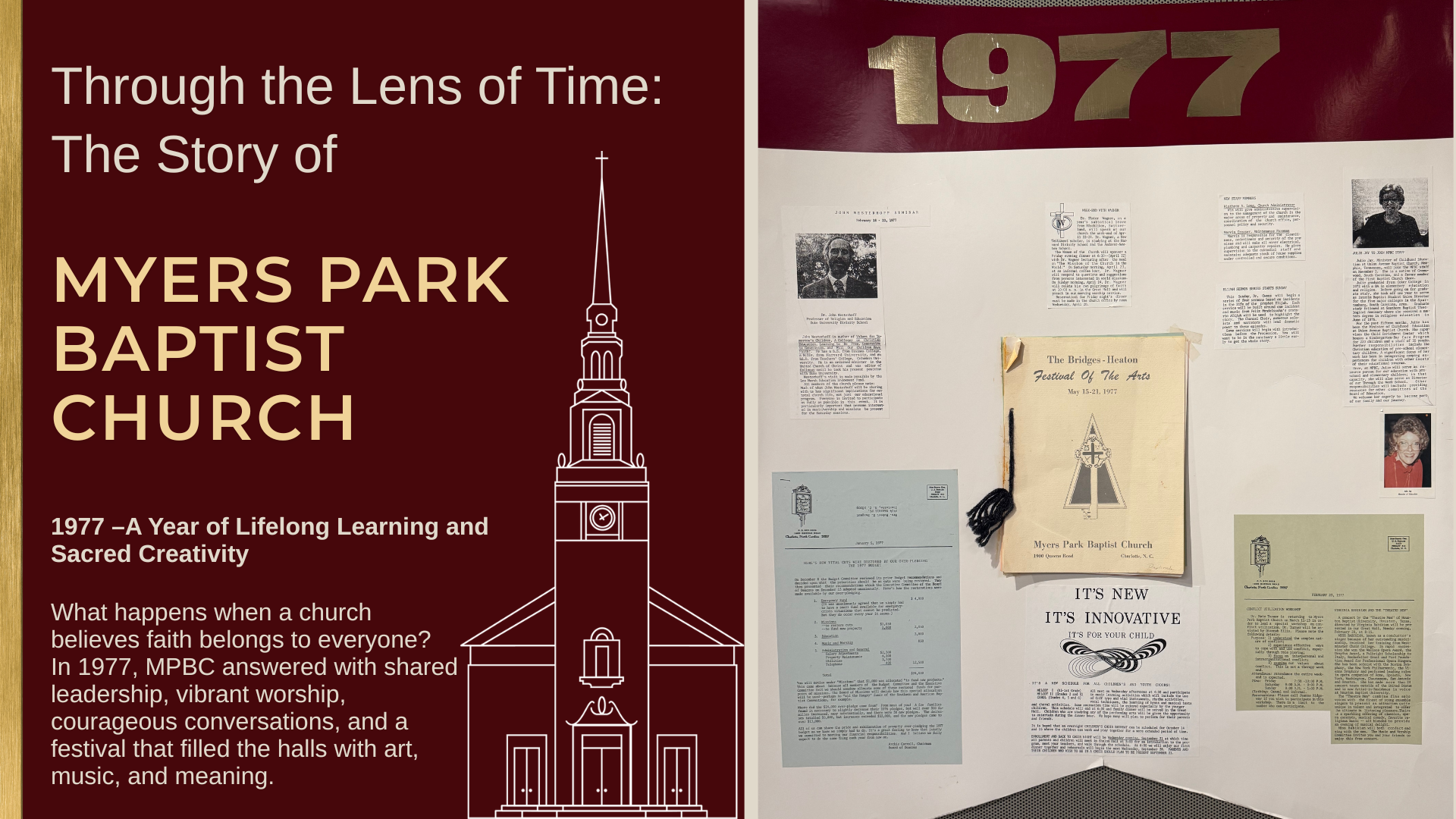
1977 - A Year of Lifelong Learning and Sacred Creativity
In 1977, Myers Park Baptist Church found itself standing on confident ground—rooted in faith, yet unafraid to explore, question, and create. It was a year marked not by quiet maintenance, but by vibrant participation: learning that shaped the whole church, worship that engaged the senses, art that spoke of God’s truth, and leadership shared across generations. Together, the congregation leaned into a vision of ministry that belonged not to a few, but to the entire community.
Faith Formed for a Lifetime: Education as the Work of the Whole Church
In 1977, Myers Park Baptist Church deepened its commitment to forming people of faith across every stage of life. A pivotal moment came with the visit of noted educator John Westerhoff, Professor of Religion and Education at Duke University Divinity School, who challenged the congregation to understand Christian education not as a program but as a way of life—shaping worship, mission, relationships, and daily practice. His seminar, made possible by the Lex Marsh Education Endowment Fund, invited the church to imagine learning as central to its communal identity.
This vision took tangible form with the hiring of Julie Jay as Minister of Education. She brought with her a master’s degree in religious education from Southern Baptist Theological Seminary and experience as Minister of Childhood Education, where she supervised a Child Enrichment Center serving 220 children with a staff of 35. Her passion for integrating camping experiences into faith formation reflected a holistic approach to Christian education. At MPBC, she served as Director of Through the Week School and as a resource for preschool and elementary ministries and the Board of Education. Her work wove together learning, community, and deep care for children and families.
Facing Conflict Faithfully: Honest Engagement as Spiritual Growth
The congregation also created intentional space for difficult but necessary conversations. Workshops such as the Conflict Utilization Seminar, led by Dr. Nate Turner and Diannah Ellis, helped participants better understand conflict as a complex and potentially transformative part of human relationships. Through teaching, role play, and self-reflection, participants explored interpersonal and intraorganizational conflict and examined their own values around disagreement. This willingness to engage conflict openly reflected a growing understanding that emotional and relational maturity is an essential part of spiritual growth.
Scripture Brought to Life: The Story of Elijah in Word and Song
Worship in 1977 was immersive and imaginative, combining music, storytelling, and theology in powerful ways. A four-part sermon series on the life of the prophet Elijah centered on key moments from his story, with each service enriched by music from Mendelssohn’s oratorio. Supported by the Chancel Choir, soloists, and narrators, these services brought biblical narrative vividly to life and demonstrated the congregation’s hunger for worship that engaged both mind and heart.
Young Voices, Shared Tables: Music as Formation for Children and Youth
The church’s music ministry continued to expand, creating new pathways for children and youth to participate fully in worship. Choir rehearsals took place on Wednesday afternoons and flowed naturally into family dinner in the Great Hall (now Heaton Hall), reinforcing the connection between worship, fellowship, and daily life.
Children’s choirs were organized by age group: Melody I for kindergarten through first grade, Melody II for grades two and three, and Carol Choir for grades four through six. Music learning included Orff and wind instruments, rhythm activities, vocal training, hymnody, choral singing, and recreational time. Children studying any performing arts were given opportunities to share their gifts with those attending dinner, and plans were underway for an overnight children’s choir retreat.
The Arts as Theology: The Bridges-Heaton Festival of the Arts
Few events better captured the spirit of 1977 than the Bridges-Heaton Festival of the Arts, a weeklong celebration that transformed Myers Park Baptist Church into a vibrant center of cultural and spiritual expression. Through visual art, music, architecture, literature, and performance, the festival reflected a theology that honors creativity as an essential expression of faith and community.
Sponsored by the Music and Worship Committee, the festival aimed “to stimulate an interest in the arts as a tool for teaching and as an expression of man’s experience of God’s truth.” Committee members included Mr. Delbert Bowles (Chairman), Mrs. Donald G. Bryant, Mr. John F. Cox, Mrs. Roddey Dowd, Mrs. George V. Irons, Jr., Mr. William D. Kendall, Mrs. J. Randall Mishoe, Mrs. C. Robert Ruppenthal, Mrs. James R. Tice, Mr. Eric Todd, and Mrs. John D. Wagster.
A dedicated Festival Committee, chaired by Mr. Delbert Bowles (General Chairman) and Mrs. James R. Tice (Steering Committee Chairman), Mrs. Fred Allen (Non-Professional Arts and Crafts Chairman), Mr. James A. Berry (Music Chairman), Mrs. George R. Buck and Mrs. Ralph H Short, Jr (Picnic Chairmen), Mrs. Bruce R. Collins (Children's Art Chairman), Mrs. George V. Irons (Drams Chairman), Mrs. Emil F. Kratt and Mrs. Paul Creasman (Poetry Chairmen), Mrs. R. T. Lucas, Jr. (Hostess Chairman), Mr. Ike McLaughlin (Film Chairman), Mr. Mark McNeal (Professional Art Chairman), Mrs. J. Randall Mishoe (Dance Chairman), Mrs. John F. Morton (Photography and Literary Chairman), Mrs. Fisk Outwater (Publicity), Mr. and Mrs. Mike Powl (Coffeehouse Chairman), Mrs. C. Robert Ruppenthal, Mrs. Winston L. Tennies (Publicity Chairman), coordinated events across disciplines, engaging professionals and community artists alike—from children to adults.
The festival opened on Sunday, May 15, with a picnic followed by a tour and lecture of the church and its architecture led by Tebee P. Hawkins, then President of the North Carolina Chapter of the American Institute of Architects. That afternoon, the Sanctuary resounded with Haydn’s The Creation, performed by the Chancel Choir and soloists Sherry Kelly, John Hayward, James Berry, William Pearce, and Gini Osborne, followed by a narrated slide presentation of scenes in England by T. J. and Jane Ellen Norman.
Monday featured performances by the Melody II Choir, directed by James Berry (Minister of Music) and accompanied by Mrs. James R. Tice. The young singers included Margaret Fields, Wendy Homes, Bailey Irwin, Hunter Kratt, Lee Mishoe, Ruffin Pearce, Jeffry Ruppenthal, Lynda Stark, Sylvia Tennies, and Cindy Tice. They were followed by A Jazz Contata for Young Singers by the Carol Choir, conducted by Fran Loftin, accompanied by Mr. Ralph Short, and with the help of choral assistant, Mrs. Wallace Osborne. The singers included: Lee Bowers, Lisa Braswell, Elizabeth Christopher, Maggie Ellis, Patrick Fields, John Harris, Margaret Johnson, Amorette Pearce, Lisa Pittman, Steve Ruppenthal, Lisa Senter, Sarah Jane Smith, Nathan Tennies, and Pam Weathers. Then the Youth Choir with Ame Alford, Lisa Bowers, Linda Carter, Mariah Currin, Sara Gurry, Jonathan Huffstetler, Bill Kratt, Laura Kratt, Melissa Morton, John Ruppenthal, Mabel Shaw, Foy Weathers, Mary Wensil, Sammy Williams, and Jeff Willis delighted the audience with songs like "Prayer for Man and His World," "A Better World," He Ain't Heavy, He's My Brother," and "Born Free" just to name a few. The Southern Bells were joined by MPBC members, Carol Allen, Priscilla Bynum, Jeanne Cole, Susan Gallant, Barbara Hiestand, Peggy Irons, Cathy Lail, Fran Loftin, Gini Osborne, Caroline Ruppenthal, and Lauretta Short. These musical presentations showcased the depth of musical talent within the congregation.
Tuesday evening brought drama with the St. John’s Baptist Players performing The Sixth Day by Lenora Cave. The drama portrays man's struggle to find God with the chorus members depicting the temptations of life.
Wednesday's focus was on visual art and architecture with exhibits, demonstrations and lectures by professional and local artists and the UNCC School of Architecture. Children got to experience Art through activities. A film festival and a Book Review with Glady Lavitan rounded out the day.
Friday offered Sacred Dance by Judy Koch from Atlanta and Saturday included workshops in poetry with Dannye Romine (author and Charlotte Observer Book Editor), drama with Gene Kusterer (Director of the Little Theatre of Charlotte), drama for children with Betsy Rawles Patterson and Eva Lee, and creative movement with Judy Koch.
.
The festival was made possible by Bridges-Heaton Founders Activities, a fund created in honor of MPBC’s first senior minister, Dr. George Heaton, through a gift from charter member Herbert Bridges, a devoted supporter of the arts in Charlotte who had served as chairman of the Arts Council Fund Drive.
Learning Beyond Borders: Global and Theological Perspective
The church’s commitment to deep learning extended beyond local boundaries. Dr. Gunter Wagner of Rushlikon, Switzerland, offered lectures, conversations, and preaching that invited the congregation to reflect on “The Mission of the Church in the World.” Through dialogue, worship, and shared stories of faith, MPBC continued to cultivate an openness to global perspectives and diverse traditions.
Shared Leadership, Shared Responsibility
Growth in ministry was matched by thoughtful attention to organization and stewardship. Winthrop (Win) Long joined the staff as Church Administrator, providing oversight in property management, personnel policy, and office coordination. Marvin Creaser was added as Maintenance Foreman, supervising custodial staff and overseeing the care, cleanliness, and security of church facilities. He even made minor electrical, plumbing, and carpentry repairs.
The congregation’s commitment was also evident financially. In 1977, pledges exceeded budgeted goals by $24,000, made possible by more than 300 families increasing their commitments and 38 new pledges. These gifts allowed previously cut items to be restored, an Emergency Fund to be established with unanimous approval, and additional funds to be allocated for new mission projects—reflecting a shared investment in both present ministry and future faithfulness.
A Church Alive with Possibility
Looking back, 1977 stands as a year when Myers Park Baptist Church embraced learning as lifelong, creativity as holy, and community as essential. Through worship, education, the arts, and shared leadership, the congregation continued to grow—not simply in size or programs, but in depth, imagination, and confidence. It was a year that affirmed a lasting truth: when ministry is shared, faith flourishes—and the church becomes fully alive.