
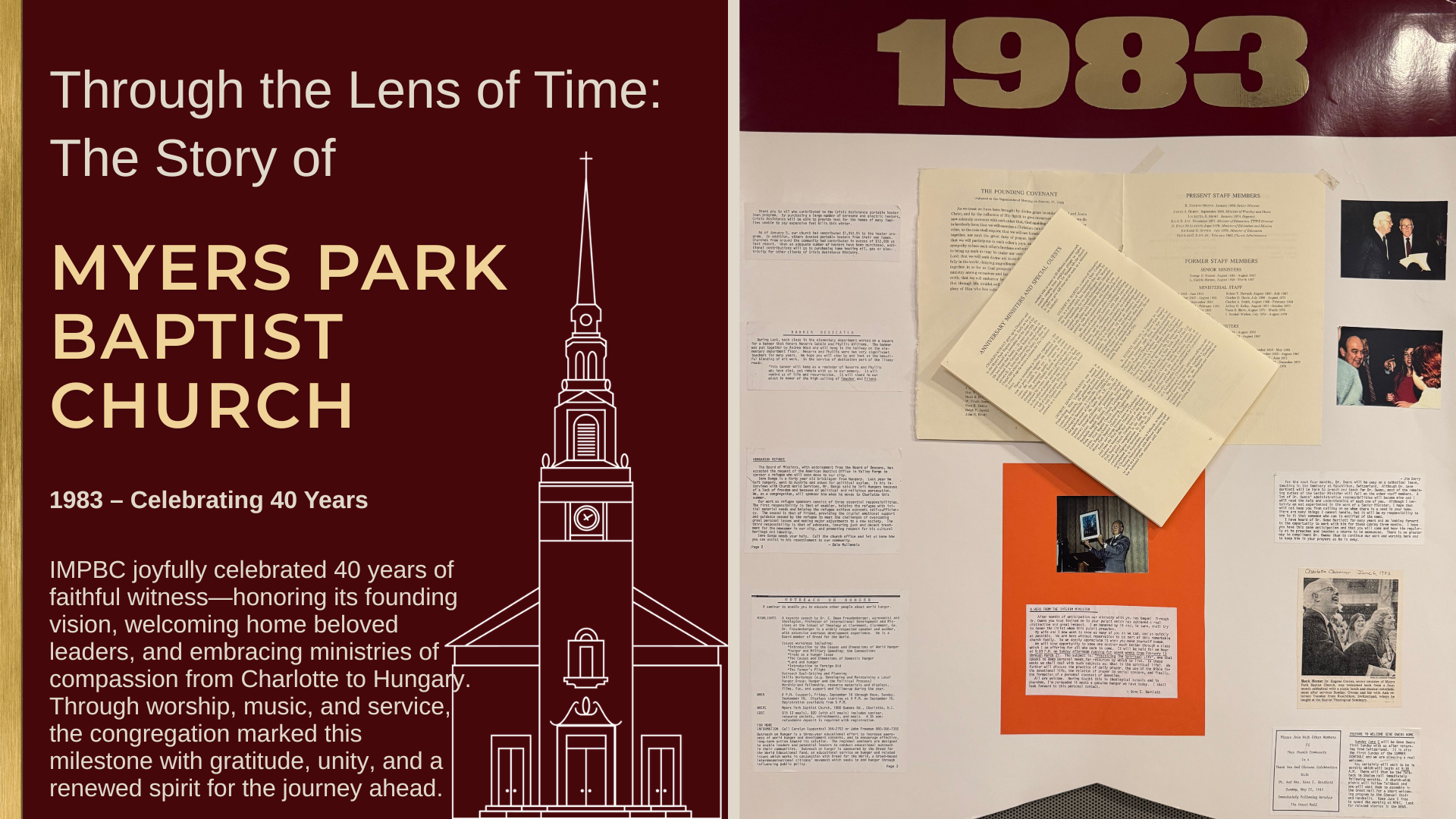
1983 - Celebrating 40 Years
The year 1983 marked a meaningful milestone for Myers Park Baptist Church—a moment when memory and mission intertwined. Forty years after a small group of lay leaders gathered with a vision for a new kind of Baptist presence in Charlotte, the congregation paused to celebrate how far it had come. What began in 1943 as a courageous experiment in faith had grown into a vibrant, thoughtful community. Yet even in celebration, the spirit of the church remained forward-looking—honoring its past not as a resting place, but as a foundation for continued discernment and faithful action.
Celebrating Forty Years of Faith and Freedom
The fortieth anniversary of Myers Park Baptist Church offered the congregation an opportunity to reflect deeply on its origins. Founded through the leadership of Lex Marsh and Frank Dowd, alongside a committed group of laymen—H. B. Benoit, J. R. Bryant, Guy Carswell, R. S. Dickson, W. Carey Dowd, Fred Helms, John R. Knott, and Dr. Wm. Marvin Scruggs—the church emerged in response to a growing need for a Baptist congregation in the Myers Park community.
Over four decades, that vision blossomed into a community known for its engaged faith and willingness to ask meaningful questions. The anniversary was not simply a remembrance—it was a reaffirmation of a shared identity grounded in freedom, inquiry, and faithful community.
Voices That Shaped the Celebration
The anniversary celebration brought together voices reflecting both the church’s history and its wider influence. Charles Kuralt, a Charlotte native who grew up at Myers Park Baptist Church, returned as guest speaker. A graduate of Central High School and the University of North Carolina at Chapel Hill, Kuralt went on to achieve national recognition as a journalist with CBS, embodying the far-reaching influence of the church’s formative years.
Music also played a central role. A special anthem, "Let There Be Light," commissioned for the occasion, was composed by Gilbert M. Martin, who was present to direct the choir in its performance during Sunday worship.
The return of founding pastor George Heaton to lead worship brought the past vividly into the present, while Dr. Eugene Owens offered reflections that encouraged the congregation to draw upon its history as a guide for faithful living in the years ahead.
A Distinctive Baptist Witness
By 1983, Myers Park Baptist Church had cultivated a distinctive identity—firmly rooted in Baptist tradition while boldly embracing openness and dialogue. Members such as C. C. Cameron described the church as spiritually enriching and refreshingly open-minded, a place where freedom of conscience and local church autonomy were not only affirmed but actively practiced.
This identity was captured in Mary Kratt’s commemorative article, A Backward Glance, which traced the church’s beginnings to a Sunday afternoon in 1942 at the Charlotte YMCA on South Tryon Street. There, the original ten laymen—Benoit, Bryant, Carswell, Dickson, Frank Dowd, W. Carey Dowd, Helms, Knott, Marsh, and Scruggs—gathered to respond to what they described as “an acute need” for a Baptist congregation in Myers Park.
Continuity in Leadership and Worship
Even amid celebration, the rhythms of church life continued. During Dr. Eugene Owens’ four-month sabbatical in Rüschlikon, Switzerland, where he taught in the seminary, Dr. Gene E. Bartlett served as Interim Minister.
In his message to the congregation, Dr. Bartlett expressed gratitude for the opportunity to serve what he described as "a pulpit of distinction and respect." In addition to preaching, he led a seven-week series titled Practicing the Spiritual Life, exploring prayer, scripture, devotion, and the relationship between spiritual practice and social concern.
Upon his departure, the congregation honored Dr. and Mrs. Gene Bartlett with a reception. Shortly thereafter, Dr. Owens’ return was celebrated with a full day of community—worship, Talk Back, a picnic, and a special program of music and welcome. His homecoming was even noted in coverage by The Charlotte Observer.
Extending Compassion Beyond Borders
The church’s commitment to mission extended far beyond Charlotte. Responding to a request from the American Baptist Office in Valley Forge, Myers Park Baptist Church sponsored Imre Bango, a forty-year-old bricklayer from Hungary who had fled to Austria seeking asylum due to political and religious persecution.
With the support of the Board of Missions and endorsement from the Board of Deacons, the congregation embraced its responsibility fully—serving as enabler, friend, and advocate. Members helped Imre establish stability, adjust to a new culture, and maintain dignity and connection to his heritage, offering a powerful witness to the church’s lived commitment to justice and compassion.
Responding to Hunger and Human Need
That same spirit of care shaped other outreach efforts. The church hosted a weekend seminar on world hunger led by agronomist and theologian Dr. C. Dean Freudenberger, equipping participants to better understand global development challenges and engage in long-term solutions.
Closer to home, the congregation responded to immediate needs through its support of the Crisis Assistance Ministry. Members contributed over $2,000 and donated portable heaters to support the Portable Heater Loan Program, while additional funds helped provide heating oil, gas, and electricity to families facing winter hardship.
Honoring Lives of Faithful Service
The life of the church was also marked by remembrance. During Lent, each elementary class contributed fabric squares that were assembled into a banner by Andrea Wood. The banner honored the lives and service of Navarra Gobble and Phyllis Williams, beloved teachers whose influence had shaped the faith of many.
Displayed in the elementary department hallway, the banner stood as a visible testimony: a reminder of lives well lived, of resurrection hope, and of the enduring impact of teachers and friends who continue to dwell in the memory and life of the church.
Looking Ahead with Faithful Purpose
As Myers Park Baptist Church marked forty years of ministry, it did so with a deep awareness that its story was still unfolding. The celebration honored a legacy shaped by leaders, teachers, servants, and visionaries—each name representing a thread in a much larger tapestry of faith.
Rooted in freedom and guided by inquiry, the congregation looked toward the future with hope. Just as Benoit, Bryant, Carswell, Dickson, Dowd, Dowd, Helms, Knott, Marsh, and Scruggs could not have imagined all that would grow from their 1942 gathering, so too the church in 1983 stood poised for what lay ahead—trusting that the same spirit that had guided them thus far would continue to lead them forward.