
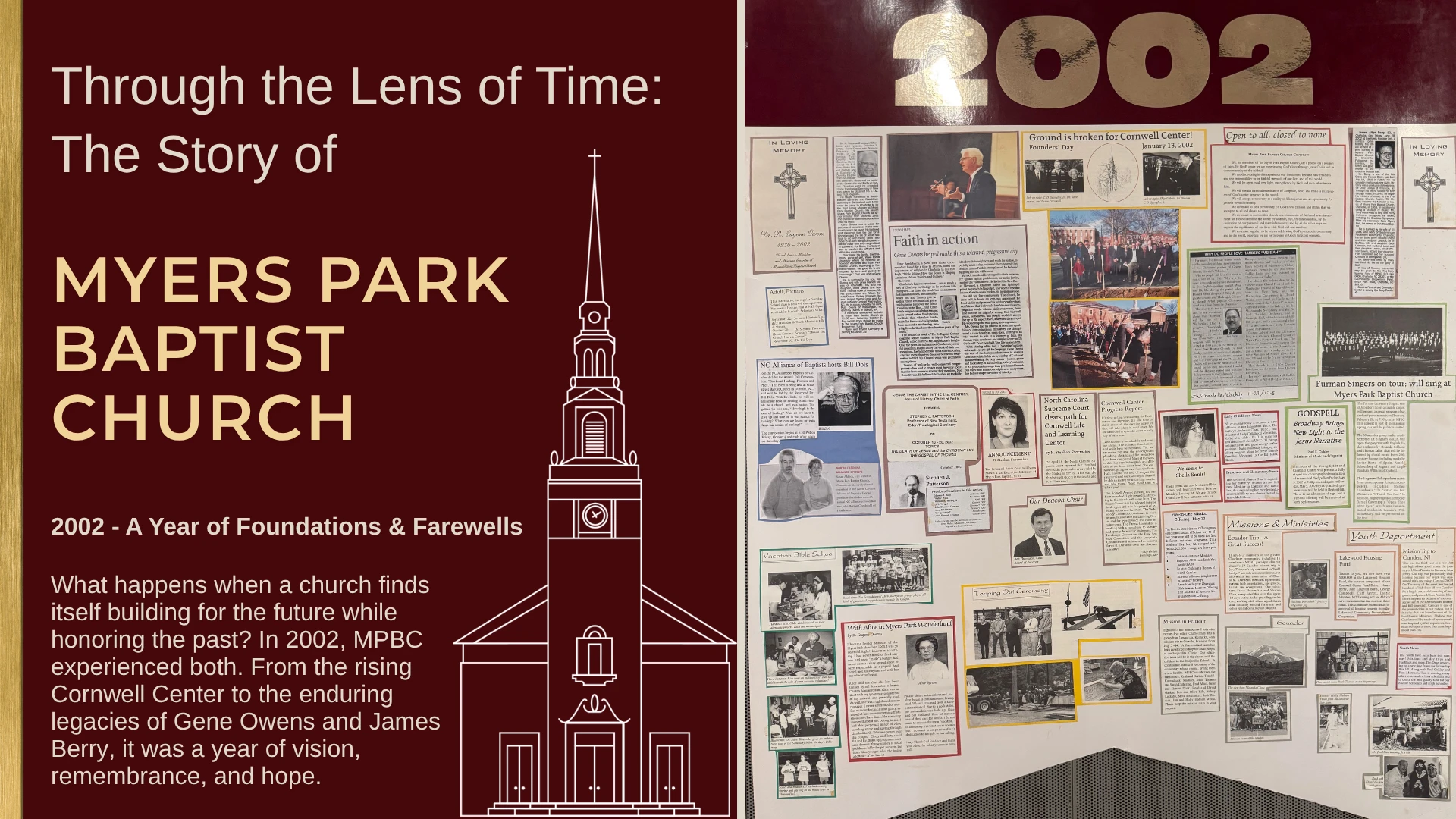
2002 - A Year of Foundations and Farewells
Some years in a church's life are remembered for dramatic change. Others are remembered for the quiet work of laying foundations, both literal and spiritual, that shape generations to come. For Myers Park Baptist Church, 2002 was a year that held both. As steel began to rise from the ground for what would become the Cornwell Center, the congregation also paused to honor beloved leaders whose ministries had helped form the church's identity. It was a year marked by vision and remembrance, construction and covenant, grief and gratitude. Through it all, MPBC continued to ask what it meant to be a community "open to all, closed to none" while building a future firmly rooted in its deepest values.
Building a Dream: The Cornwell Center Takes Shape
By 2002, years of planning, prayer, and perseverance were beginning to bear visible fruit. What had once existed as a bold vision was becoming a reality as construction moved steadily forward on the Cornwell Life and Learning Center.
Building Chair Skip Gribble reported that the project remained on schedule, with foundations and walls poured and essential underground infrastructure already completed. Much of the work had taken place below street level, hidden from public view, but by late summer structural steel would begin to rise, offering the congregation its first tangible glimpse of the building taking shape.
The excitement extended far beyond construction crews. Committees throughout the church were actively preparing for the center's opening. Teams worked on interior finishes, technology systems, fitness equipment, landscaping plans, food service operations, and even the creation of a labyrinth. The sense of anticipation was unmistakable. As Gribble wrote, "Our dream will soon become a reality."
The year also brought significant legal news. On April 18, the North Carolina Supreme Court declined to review the final challenge brought by the Medearis family regarding the project. Announcing the decision, Dr. Stephen Shoemaker noted that it represented the third consecutive court victory and effectively cleared the way for the Cornwell Center's completion.
Photographs throughout the year captured key moments in the journey, including groundbreaking ceremonies featuring C. D. Spangler, Jr., Ilease Cornwell, Dr. Stephen Shoemaker, Skip Gribble, and Ed Hinson, as well as the symbolic "Topping Out Ceremony" that marked another milestone in the center's construction.
As the building rose, so too did excitement about the ways it would serve both church and community for years to come.
Renewing the Covenant
While concrete and steel transformed the church campus, MPBC also reaffirmed the values that defined its spiritual foundation.
In 2002, the congregation revisited its church covenant, a statement that had become one of the clearest expressions of the church's identity. The covenant affirmed a commitment to intellectual honesty, spiritual freedom, faithful stewardship, and the understanding that controversy could become an opportunity for growth rather than division.
Its most memorable declaration continued to resonate deeply:
"We covenant to be a community of God's new creation and affirm that we are open to all and closed to none."
Those words reflected not only who Myers Park Baptist Church had become but also who it aspired to be. At a time when many churches were drawing sharper boundaries, MPBC continued to embrace a vision of hospitality, inclusion, and thoughtful faith.
Saying Goodbye to a Prophetic Voice
On October 1, 2002, Myers Park Baptist Church and the wider Charlotte community lost one of their most influential voices with the death of Dr. R. Eugene Owens, Senior Minister Emeritus.
Owens had served as MPBC's third Senior Minister from 1969 until 1992 and continued his ministry as Minister Emeritus until his death. During more than two decades of leadership, he helped shape both the church and the city through his unwavering commitment to justice, compassion, and courageous faith.
Those who knew him remembered a preacher whose understanding of the Gospel extended beyond personal piety into active concern for those living on society's margins. He often reminded the congregation that Christian faith was less about being "good" and more about living compassionately and pursuing justice.
An editorial published in The Charlotte Observer following his death described Owens as one of the voices that helped make Charlotte a more tolerant and caring city. He spoke against the Vietnam War, advocated for racial justice, opposed capital punishment, and welcomed difficult conversations when others might have avoided them. He believed that "the church is based on love, not agreement," a conviction that continues to echo through the life of Myers Park Baptist Church.
With his booming voice, poetic language, and fearless commitment to the Gospel's demands, Gene Owens left an enduring legacy. His ministry helped strengthen the church's identity as a congregation willing to engage difficult questions while remaining anchored in grace.
Honoring Lives of Faithful Service
The church also mourned the loss of another cherished leader in 2002.
James Alton Berry, who served as Minister of Music beginning in 1958, died on June 28 at the age of 82. Through decades of ministry, Berry shared his faith through music, enriching worship at Myers Park Baptist Church and touching countless lives.
A graduate of Westminster Choir College and a Navy veteran of World War II, Berry brought both excellence and devotion to his work. His ministry extended far beyond the church walls as he performed with orchestras across the nation, including the Charlotte Symphony. Yet those who knew him best remembered his deep faith and humble spirit.
As his obituary simply stated: "Mr. Berry was loved by many and lived his life to the glory of God."
The year also provided an opportunity to celebrate the faithful service of Alice Byram, whose stewardship and administrative leadership had quietly sustained the church for decades. In a heartfelt tribute, Gene Owens reflected on Alice's dedication, wisdom, and unwavering commitment to responsible stewardship, describing her as a person whose work was truly a calling.
New Leaders for a New Chapter
As one generation of leaders was remembered and honored, another stepped forward to guide the church's future.
The congregation welcomed The Reverend Robin Coira as Executive Minister and Sheila Ennis as Minister of Education. Dr. Kathryn Andersen Clark (Katie) joined the staff as Director of Early Childhood Ministries, bringing expertise in maternal and child health along with a passion for children's ministry.
Meanwhile, The Reverend Sharon Doar expanded her role as full-time Minister to Children and Families, broadening her ministry to include younger children and their families.
These transitions reflected a church continuing to invest in education, spiritual formation, and family ministry while preparing for future growth.
Faith in Action at Home and Abroad
Mission remained central to MPBC's identity throughout 2002.
The church's Fifth Ecuador Mission Trip brought together thirty-four participants from across the Charlotte community, including eighteen members from Myers Park Baptist Church. Ministers Steve Shoemaker and Sharon Doar joined the team as they provided healthcare, worked with children, and completed construction projects in the Andes region.
Back home, members contributed generously to the Five-in-One Mission Offering, supporting organizations such as Crisis Assistance Ministry, the Regional AIDS Interfaith Network (RAIN), Baptist Children's Homes of North Carolina, St. Peter's Homes, and mission causes supported through both the American Baptist Churches USA and the Alliance of Baptists.
The church also strengthened its commitment to affordable housing through the Lakewood Housing Fund, which surpassed $100,000 in support of development efforts within the Lakewood community.
Meanwhile, MPBC youth continued their annual partnership with Urban Promise Ministries in Camden, New Jersey. Their work during Carnival 2002 provided encouragement and hope to hundreds of children while deepening their own understanding of faith in action.
Whether in Charlotte, Ecuador, or Camden, the congregation continued to embody its conviction that faith must find expression through service.
Exploring Faith Through Education and Music
Lifelong learning remained a hallmark of Myers Park Baptist Church in 2002.
Adult Forums welcomed scholars and speakers who encouraged thoughtful engagement with faith, including Dr. Stephen Patterson, noted scholar of the historical Jesus. The ongoing "Jesus the Christ in the 21st Century" series continued MPBC's tradition of exploring Scripture through rigorous scholarship and open conversation.
Music likewise flourished throughout the year. The renowned Furman University Singers performed at the church, while youth choirs presented a fully staged production of Godspell, bringing fresh creativity to the story of Jesus.
Minister of Music Paul Oakley enriched the congregation's appreciation of sacred music through special programs and performances, including presentations on Handel's Messiah, a work that remained an important part of Advent and Christmas worship at Myers Park Baptist Church.
These ministries reflected the church's enduring belief that faith grows through learning, creativity, and meaningful engagement with both tradition and new ideas.
Looking Back
In retrospect, 2002 was a year of foundations.
The foundations of the Cornwell Center were poured into the earth, preparing the way for a landmark ministry that would soon serve both church and community. At the same time, the congregation reflected on the deeper foundations upon which Myers Park Baptist Church stood: a covenant of inclusion, a commitment to justice, a passion for learning, and a faith expressed through service.
The church celebrated new leaders, honored faithful servants, expanded its mission efforts, and said farewell to beloved voices whose influence would continue long after they were gone.
By year's end, steel beams were rising toward the sky, but the more important story may have been the one unfolding within the congregation itself. Even amid change, loss, and transition, Myers Park Baptist Church remained rooted in the convictions that had guided it for generations. In 2002, the church was not simply building a center. It was building on a legacy. And that legacy, strengthened by both memory and hope, would carry MPBC into the years ahead.